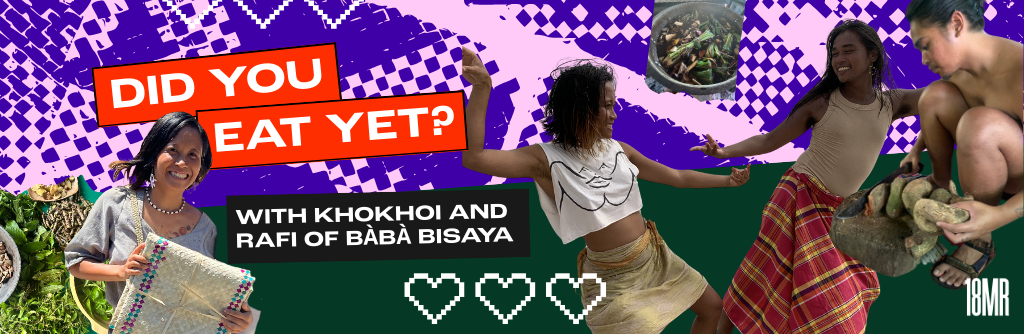
Hello! We are Khokhoi and Rafi, co-founders of Bàbà Bisaya – a Visayan language learning school. Our vision is to connect diasporic and urbanized Filipino communities to local island roots through language. We dream of worlds where diaspora deepen relationships of care. From the motherlands to planetary histories of displacement, we make homes in our bodies and communities.
Khokhoi: Hello! I’m Khokhoi, a movement-based artist-anthropologist and a plant, body & cultural heart worker. I weave eco-sensual, ancestral & embodied modes of relation into transoceanic community building and decolonial co-creation. I started Kalami Spirit Arts as a creative healing arts studio. We embrace and explore the felt sense of ‘yumminess’ that emerges in connection to our diverse ecologies.
My practice invites embodied curiosity and creative connection to ancestral ecological and cultural heritage through a decolonial approach to history, memory, ritual & healing arts.
Rafi: Hi! I’m Rafi. I’m a queer cultural worker, language educator, movement artist, and bodyworker. Through Bàbà Bisaya Language Immersions, I co-create learning environments for communal relationships with Bisayan islander cultures. Born and raised in Buglas (Negros Island, Philippines), I am now rooted on the Ohlone-Ramaytush lands of Oakland, CA.
I’ve also built spaces for community gatherings through Uliràt that center collective grief and joy–whether from the historical or present. Part of this heartwork was connecting with survivors and translating their accounts of the Escalante Massacre (1985) on my home island.
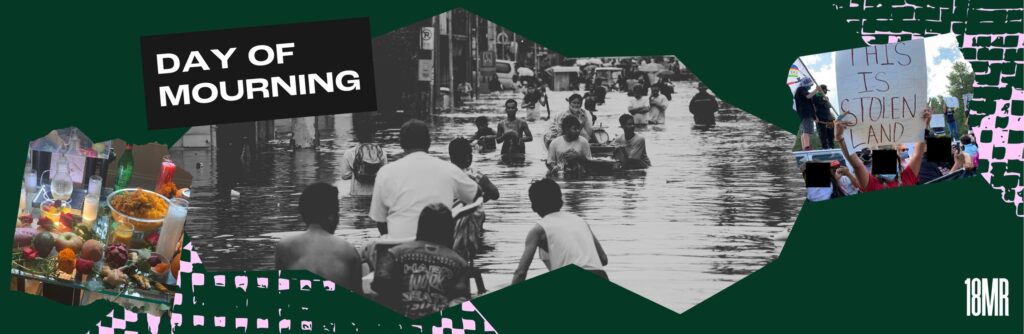
Khokhoi: This Day of Mourning, I am experiencing the heartache of loss of native life due to ongoing climate change disasters. From the devastating typhoons in the Philippines to the destructive hurricanes in Jamaica, many Indigenous and native peoples around the world are forcibly displaced from ancestral homelands. And it’s because of the unregulated greed of Global North companies.
In native spiritual traditions, we would never change the land or the environment without giving something in return. When we plant seeds in the dirt or launch a boat to the sea, we offer prayers and offerings of gratitude to the spirits of the lands and waters. Unfortunately, native and Indigenous peoples around the world bear the impact of colonial projects that destroy and desecrate, without this exchange.
May this ‘holy day’ be a reminder that our mere human lives exist in a dense ecosystem of diverse spirits. To coexist and create within this ecosystem, we must humbly ask for permission and protection. We must offer our gratitude and grief to the lands and its caretakers to be in honorable integrity.
Rafi: I want to highlight the cultures of connection that colonial powers smokescreen away from us. Farther from each other, farther from our histories, farther from our embodied practices. An invitation to inquire what is local to us that we impact and can deepen relationships with.
Every “Thankstaking” is an invitation to inquire what it is that is rightfully ours. Ancestral gifts, our seeds, our food, our languages, our relationships to waters, lands, and more-than-human friends. As many gather to celebrate a colonial holiday, we invite you to reshape what it means in your own sovereign practice.
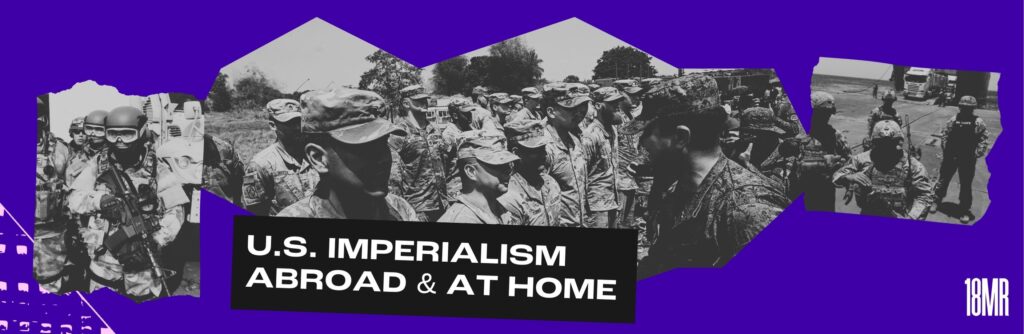
The forced displacement of native peoples is an age-old strategic practice in colonizer playbooks. In the Philippines, the floods are not simply from the climate crises, but also political corruption. Funds intended towards flood control are instead stolen from the people. Instead of protection, the government funnels money to mining and luxury development. This results in annual loss of life, affecting the most vulnerable: Indigenous peoples, urban poor, farmers and fisherfolk.
This disregard for native life in pursuit of foreign capital is what ‘the Philippines’ as a Spanish colony was originally built on. Most nation-state projects never intended to include native peoples. Rather, these projects aimed to turn local populations into colonial subjects.
Much like the genocide of the Indigenous peoples on Turtle Island, the U.S. military enacted massacres in the Philippines. They targeted the Indigenous peoples of the Philippine archipelago, forcing them to become part of the ‘Filipino’ nation. And we continue to witness this same tactic with the violent erasure of native Palestinian peoples, lands and sovereignty.
Khokhoi:
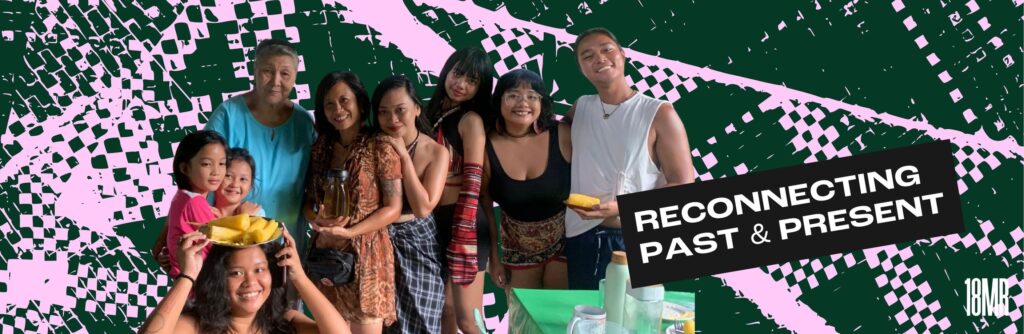
In today’s world of fixed uncertainty, I commit to ritual creative acts of cultural and ecological regeneration. These ritual acts are where the past lives on to birth plural futures. In community with a marine sanctuary guardian and four generations of coastal folks in Bantayan, we’ve started a coral restoration practice. Using the embodied knowledge of my fisherfolk ancestors, I freedived, explored, and developed an archival web-project: Ubos Sa Dagat: The Under Sea. Art-making is a way to open our imaginations and also co-create new worlds!
My heart work supports rigorous research reconnecting to ancestral knowledge. Through cultural workshops on Buddhism, Yoga and Spirituality in pre-Philippines, I traverse “new age” timelines and rewire pathways to ancient Asian spiritual wisdoms. Right now, we’re amidst our virtual Baba Bisaya language immersions. We’ll be uploading our Badlit or Sulat Binisaya virtual workshops soon. In late spring, we are embarking on our first in-person immersions in the Philippines – stay tuned!
Rafi:
Through mounting Bàbà Bisaya Language School these past years, growing my practice as an educator has informed my work to support on-the-ground community spaces like Sama Sama Cooperative in Oakland, where we connect Filipinx youth with our languages, music, art, and dance through dedicated and immersive summer camps.
Khokhoi:
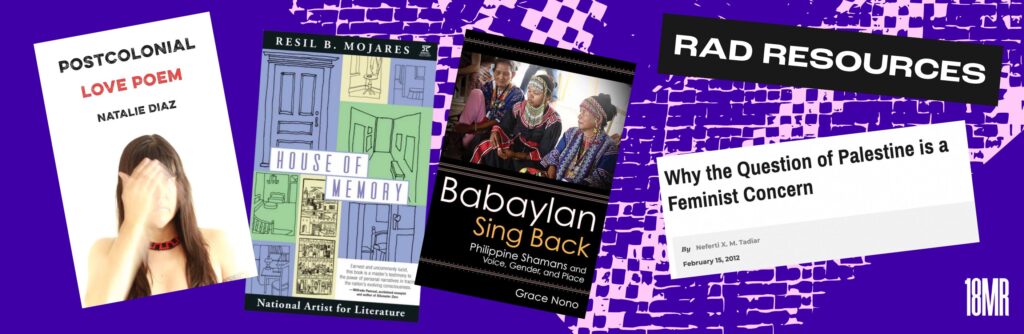
- “House of Memory” by Resil Mojares is a collection of essays from a renowned Cebuano historian, scholar and writer
- Grace Nono’s “Babaylan Sings Back” depicts the embodied voices of Native Philippine ritual specialists, honoring their history and anticolonial resistance.
- An older article, but still highly relevant! Don’t leave Neferti Tadiar’s “Why the Question of Palestine is a Feminist Question” off your reading list.
- Karakoa Productions is a theater group bringing precolonial Visayan culture and history to entertainment and the arts.
- Lastly, choose love with Mojave American poet Natalie Diaz’s Postcolonial Love Poems.
In solidarity,
Khokhoi & Rafi + Leyen, Sunee, Sonia, Turner, Van, Sharmin, Allison, and Irma – the 18MR Team
P.S. If you’ve enjoyed reading our monthly newsletter, would you chip in $5 so we can keep inviting rad guest editors?